 Dennis Papadopoulos
 That orange-brown ring around your basement floor drain isn’t a stain. It’s a confession. Somewhere under your slab, a pipe that was installed while Eisenhower was in office has been quietly rusting from the inside out for sixty years, and it’s finally telling you the truth. I’ve stood in enough century-old hallways to know the look on a homeowner’s face when the plumber says the words “replacement estimate.”
Here’s what most of those homeowners don’t hear, and it’s the reason I keep writing about this: you often don’t have to tear out the floor. Cast iron pipe relining lets you rebuild a failing drain line from the inside, working through existing access points, without excavating your foundation or destroying a finished basement. For a lot of older properties, it’s the difference between a manageable repair and a five-figure demolition project.
For homeowners in older Jacksonville neighborhoods, where slab foundations meet decades of root intrusion from mature oaks, cast iron pipe relining has become a normal repair rather than a last resort. Whether it’s the right move for your specific pipe is a different question, and it comes down to what the inside of that pipe actually looks like.
Why Cast Iron Fails on a Schedule, Not a Whim
Cast iron isn’t a bad material. It was arguably the best drain material available for most of the twentieth century, which is why it’s still under millions of American homes. The problem is what happens to iron when it spends fifty years carrying warm, slightly acidic water and the occasional dose of drain cleaner.
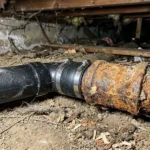
The pipe corrodes from the inside. A four-inch interior can narrow to three inches, then two and a half. You don’t notice for years, because the pipe still drains. Then one Tuesday morning the washing machine empties and the toilet gurgles, and suddenly you’re a plumbing expert.
Scale builds in rough, tubercular lumps along the inner wall. Hair and grease catch on those lumps, and the line clogs in the same spot every few months no matter how many times you snake it.
The pipe itself gets brittle near the joints. That’s where roots find their way in, and according to the Centers for Disease Control and Prevention, aging water and wastewater infrastructure is a genuine public health concern, which is why municipal systems spend billions on rehabilitation instead of replacement. Your house has the same problem at a smaller scale.
I’d rather patch a good pipe than replace a tired one, and I’ll say that plainly. But the honest rule is this: relining fixes the pipe’s condition, not its position. A sagging line with a belly that holds standing water is a drainage problem, and a new liner inside a sagging pipe just gives you a smoother sag.
What Actually Happens During the Process
A relining job starts with a camera inspection, and if a contractor skips straight to a quote without one, that’s your cue to call someone else. The camera tells you the pipe’s true diameter, where the breaks are, and whether the line is straight or has settled.
From there, the crew cleans the pipe. High-pressure jetting strips out grease, scale, and root mass so the new liner has a surface to bond to. Then a felt or fiber tube soaked in epoxy resin gets pulled or pushed through the existing pipe, inflated against the walls, and left to cure. When it hardens, you’ve got a smooth, jointless pipe inside the old one.
Since the liner forms a continuous tube, there are no joints left for roots to exploit. That’s the part that surprises people. What took root in a joint can’t get back in through a wall that doesn’t have one.
The job usually finishes in a day or two for a typical residential line, and you’re back to using your drains with normal care while the resin cures. No concrete cutting. No trench across the front lawn. No hotel stay while your only bathroom sits behind caution tape.
The Rite Decision Test: Four Questions Before You Spend a Dollar
I made this up after watching too many homeowners get talked into the wrong job, and I use it every time someone asks me whether to reline or replace. Call it the Rite test, because it’s about doing the right thing for the pipe you actually have.
- Is the pipe structurally whole but rough inside? If the camera shows corrosion, scale, or root intrusion but the pipe still holds its shape and grade, relining is usually the stronger call.
- Is it crushed, collapsed, or badly misaligned? Relining needs a round-ish host pipe. If sections have flattened or separated, spot repairs or replacement come first.
- How much of the line is affected? One bad section is a repair. Sixty feet of failing pipe is a relining conversation.
- What’s above the pipe? Finished basement, tile floor, mature landscaping, or a driveway? The more expensive the surface, the more relining earns its keep.
Two yes answers on the first and fourth questions, with clean answers on the middle two, and I’d reline without much agonizing. If the second question comes back ugly, no amount of cost savings makes a liner the right answer.
The Money Math Nobody Wants to Do
A full repipe means excavation, concrete removal, new pipe, backfill, and restoration. You’re paying for labor that has nothing to do with plumbing, plus the disruption of living in a construction zone. Relining concentrates the cost in the liner and the crew, which is why it usually lands well below replacement, though the gap narrows on short, easily accessed runs.
The federal government has been funding rehabilitation over replacement for decades, and the U.S. Department of Housing and Urban Development has long tied healthy housing conditions to occupant wellbeing and property value. That same logic applies to your drain line. A working system protects the home. The method matters less than the result.
Here’s the scenario I keep coming back to: a 1950s ranch with a slab foundation, original cast iron, and a laundry room tile floor poured in 1997. Replacement means cutting that tile, jackhammering, and repouring. Relining means two guys, a hose, and a camera. When the surface above a pipe is worth more than the pipe, relining wins on arithmetic alone.
What to Ask Before You Hire Anyone
- Will you show me the camera footage and walk me through it? A contractor who won’t share the video is hiding something.
- What’s the liner material and how long is the manufacturer’s warranty?
- What happens if the liner fails at a joint three years from now? Get the answer in writing.
- Are you licensed and insured for this work in my state?
- Does the scope include post-installation camera verification? It should.
The Environmental Protection Agency notes that aging pipe systems across the country need repair or replacement, and the practical reality is that most of them can’t be dug up. Your house is a tiny version of that same story.
One Decision, Made Once
Cast iron fails slowly, which is a gift. It gives you time to inspect, think, and choose deliberately instead of paying emergency prices on a holiday weekend. Use that time. Get the camera footage. Ask the four questions. Compare a real relining quote against a real replacement quote, not against your worst-case imagination.
If your pipe is rough but structurally sound, relining gets you a smooth interior, no root-prone joints, and a foundation that stays intact. If it’s collapsed, you’ll know that too, and you’ll know before anyone swings a hammer.
Call a licensed pipe lining contractor, ask for the inspection, and watch the video yourself. The pipe has been waiting sixty years to tell you what’s wrong. It’s worth twenty minutes to listen.